World Cup 2026 Betting Is Breaking Records - Here Is What Is Driving It
 Ethan Moore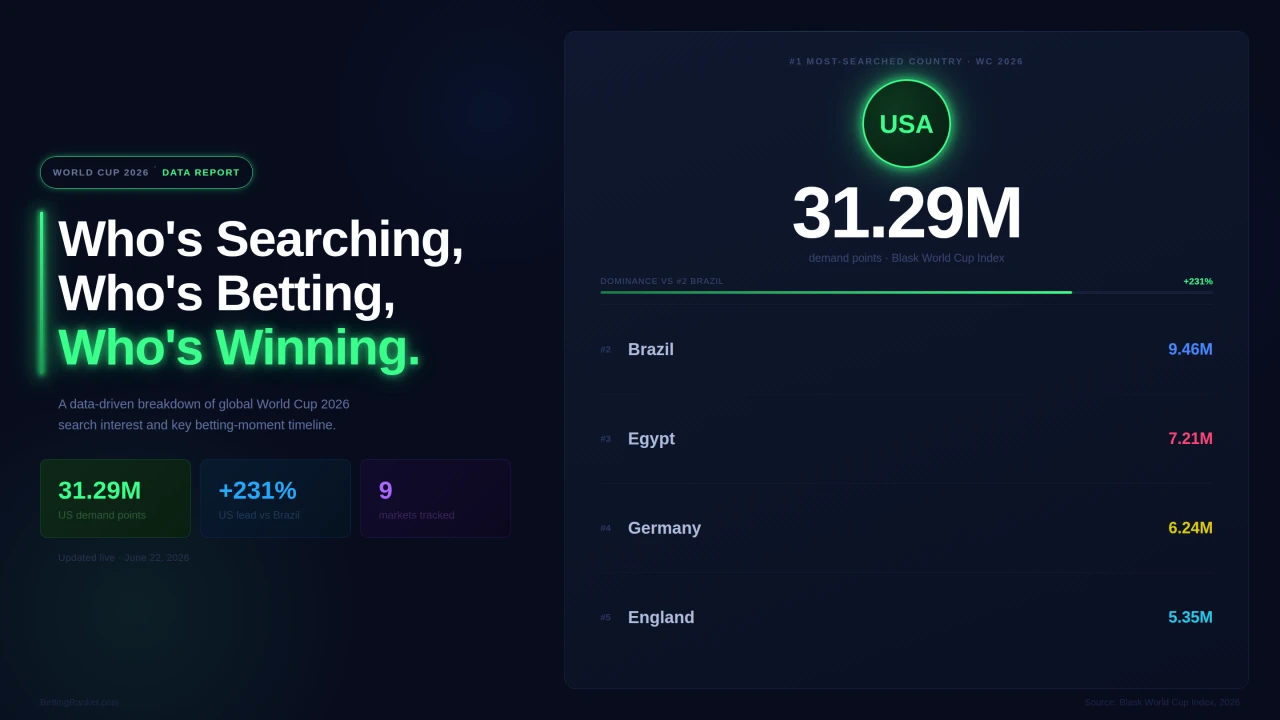
The group stage is barely a week in, and you cannot escape it - every phone screen, every bar, every office Slack channel is World Cup 2026, and the numbers behind it are already unlike anything we have tracked before.
We tracked global search and betting-interest data from Blask's World Cup Index and wagering forecasts from H2 Gambling Capital covering the tournament's build-up and opening matchdays, and the picture that emerges is consistent across every source: this World Cup is generating betting demand at a scale no previous tournament has matched - and the United States, not Brazil, not Argentina, not any of the sport's traditional powers, is driving more of that demand than any other country on earth.

H2 Gambling Capital projects that $50 to $60 billion will be legally wagered on the World Cup 2026 worldwide - a 71% jump from its 2022 estimate. No other global sporting event comes close to generating this volume of legal betting activity in a single month.
H2 estimates that the three North American host nations - the US, Mexico, and Canada - will combine for roughly $5.7 billion of that global handle, with the US alone forecast to contribute between $2.8 and $3.3 billion, depending on how far the USMNT advances. Brazil, wagering on a World Cup for the first time through a fully regulated domestic market, is a separate and fast-growing story in its own right.
This is not simply a bigger version of past tournaments. It is a structural shift in who is betting, where they are betting from, and how quickly on-pitch results translate into spikes in search and wagering activity.
What the Data Shows
Before breaking down individual markets, it is worth clarifying what "interest" measures here. Blask's World Cup Index tracks real-time global search demand for World Cup and betting-related terms by country, giving a live read on where attention - and, by extension, betting activity - is concentrated as the tournament unfolds. It is a leading indicator, not a measure of actual handle, but it correlates closely with wagering volume as seen by licensed sportsbooks.
As of right now, the United States sits alone at the top of that index with 31.29 million demand points - more than three times Brazil, the next-closest country. The rest of the global top ten spans co-host nations, traditional football powers, and markets few would have predicted a decade ago:
- United States (31.29M): No country is close. Legal sportsbooks now operate in 38 states, reaching roughly 65% of the US population, and the national team's run through the group stage - a 4-1 win over Paraguay followed by a 2-0 win over Australia that clinched a knockout spot - has kept search demand climbing through every matchday.
- Brazil (9.46M): The clear number two globally, and notable because this is the first World Cup Brazilian bettors can wager on through a fully licensed domestic market, which launched on January 1, 2025. Brazil opened the tournament with a 1-1 draw against Morocco before a 3-0 win over Haiti.
- Egypt (7.21M): One of the tournament's bigger surprises. Egypt's presence ahead of several traditional European powers shows how unevenly betting interest is distributed relative to football pedigree alone.
- Germany (6.24M): A 7-1 opening win over Curacao produced one of the sharpest single-day interest spikes of the tournament so far - our data shows German search demand up more than 83% day-over-day.
- England (5.35M) opened with a 4-2 win over Croatia, and its index has climbed more than 77% in a single day during the opening matchdays - among the largest daily jumps of any major market we have tracked so far.
- Australia (4.07M) and Canada (4.01M) round out the top seven, reflecting fast-growing betting markets in Asia-Pacific and a co-host bump for Canada, which opened with a draw against Bosnia and Herzegovina before a 6-0 win over Qatar.
- Mexico (3.96M) and France (3.66M) complete the global top nine, with Mexico drawing on its co-host status and France on its status as one of the tournament favorites.
- Saudi Arabia (2.48M), rounding out the top ten despite the fact that gambling is illegal domestically - a clear signal that real demand is routing through offshore and international platforms regardless of local law.
The pattern that stands out across this list is not which countries have the strongest football culture. It is which countries have combined football passion with legal, accessible betting markets - and the US is the clearest example of what happens when both align at once.



The Goals That Moved the Market
If there is one thing this tournament has already proven, it is that individual moments on the pitch can move global betting interest faster than any forecast accounted for. We have been tracking this match by match, and the volume of talking points in just over a week has been extraordinary.
Messi's Hat-Trick, Klose's Record Equaled - and Now Broken
Argentina opened its title defense against Algeria, and Lionel Messi did not wait long to remind the world why this is likely his last dance. He scored three goals - his first-ever World Cup hat-trick - in a 3-0 win in Kansas City, pulling him level with Miroslav Klose's all-time record of 16 World Cup goals. The first goal was the one that stopped people mid-scroll: Algeria gave him too much space in the middle of the field, and he punished them with the kind of finish that makes you question whether the laws of physics apply to him the same way they do to everyone else.
Then came today. Against Austria at AT&T Stadium in Dallas, Messi missed a penalty in the ninth minute - uncharacteristically pulling his shot wide and briefly setting an unwanted record for the most missed penalties in World Cup history. The football world held its breath. He made them wait until the 38th minute. Thiago Almada whipped a precise cross into the box, Enzo Fernandez let the ball run through his legs, and Messi finished it calmly into the corner for goal number 17 - the new all-time men's World Cup scoring record, his alone. His teammates swarmed him. He was visibly emotional. He turns 39 in two days.
He was not done. Messi came back on in the second half and scored again to make it 2-0, his 18th World Cup goal, extending the record he had just broken. Argentina won 2-0. The record now sits at 18 and counting -- with Jordan still to come in the final group game on June 28.
"Messi's hat-trick did not just boost Argentina's betting numbers -- it moved global search interest well beyond anything the match scoreline alone would justify. When he equalled Klose's record, we watched demand spikes emerge in markets that were not even playing that night. When he broke it, the whole world stopped. When he scored again, people started asking how far this actually goes."
While Messi was writing history in Dallas, the other two names on everyone's lips were watching their own clocks.
Ronaldo and Portugal face Uzbekistan on June 23 in Houston: Portugal was held 1-1 by DR Congo in their opener and needs a win to stay on track. At 41, Ronaldo has eight World Cup goals to his name and the whole tournament still ahead of him. Whether he adds to that tally against Uzbekistan will be one of the next major storylines we are tracking for betting search demand.

Yamal and Spain, meanwhile, face Uruguay on June 26 in Guadalajara: in what is shaping up as their real group-stage test. Spain has four points from two games, but Yamal has yet to play a full match - he has been eased back from a hamstring injury through the group stage. The Uruguay game is the one where de la Fuente is expected to start him. When that happens, we expect another demand spike.

Germany 7-1 Curacao: The Goal That Became Something Bigger
Germany's destruction of Curacao was predictable in outcome, if not in margin. But the story that came out of it was not Germany's - it was Curacao's. The Caribbean island nation of 158,000 people, one of the smallest ever to qualify for a World Cup, pulled one back through 22-year-old defender Livano Comenencia with a laser-like strike past Manuel Neuer. For 17 minutes, Curacao had equalized Germany. The footage of their fans losing their minds in the stands is some of the most joyful content this tournament has produced.
Goalkeeper Eloy Room summed it up perfectly after the match:
"We support each other, we are small islands."
A country the size of one-fifth of Delaware scoring at a World Cup, against Germany, in front of the world. The betting market barely registered it. The football world did not forget it.
Cape Verde Hold Spain 0-0 - and Nobody Saw It Coming
Spain arrived at their opener against Cape Verde as one of the tournament favorites. Cape Verde arrived as a nation of 525,000 people, playing in their first-ever World Cup after qualifying by winning their African group ahead of Cameroon. One of their defenders, Roberto "Pico" Lopes, left a banking job in 2017 to play professionally and was recruited to the national team via LinkedIn.
Spain took 27 shots and did not score. Cape Verde held on for a famous 0-0 draw.
Then there is Vozinha. The Cape Verde goalkeeper is 40 years old, had a few thousand Instagram followers before kick-off, and spent 90 minutes making save after save against a Spain side that took 27 shots and could not find the net. By the time the final whistle went, his follower count had exploded past ten million. He did not change his game, his style, or his demeanor - he just kept the ball out of the net against one of the best attacking sides in the world and let the internet do the rest.
It became, as several outlets reported, the biggest lost bet in World Cup 2026 history up to that point. From a betting-interest standpoint, we tracked a dramatic spike in Group H search activity immediately after the final whistle - not driven by Spain bettors celebrating, but by the sheer volume of shocked traffic looking for what just happened. Cape Verde then pushed Uruguay to a 2-2 draw in their second game, with Kevin Pina scoring the island nation's first-ever World Cup goal.
Worth noting: on the same day as the Cape Verde opener, Real Madrid confirmed they had signed Marc Cucurella from Chelsea for around €55 million - and De la Fuente was asked about it at the pre-match press conference. This is the same De la Fuente who had just named the first Spain World Cup squad in history with zero Real Madrid players, calling his selection "perfect" and declaring the best players are not just at Madrid. He welcomed the news warmly. Twenty-four hours later, Cucurella was Spain's best player on the pitch against Cape Verde. The football gods have a sense of humor.
Lamine Yamal, 18 Years Old, Opens the Scoring Against Saudi Arabia
When Spain came back out for their second match - this time against Saudi Arabia - Lamine Yamal was fit to start after recovering from a hamstring injury. He needed ten minutes. His goal in the 10th minute opened Spain's 4-0 win and, at 18 years and 343 days old, made him the eighth-youngest goalscorer in World Cup history. Nico Williams and Mikel Oyarzabal added to the tally - Oyarzabal with a brace - before an own goal by Hassan Al-Tambakti rounded it off at four.
The stat that really landed: he scored his first World Cup goal just 14 days younger than Lionel Messi did at his first tournament. He also became only the second player aged 18 or younger to score the opening goal of a World Cup match - the first was Pelé, in 1958.
So, Where Was Ferran Torres?
As for Ferran - and we are going to call him Ferran, because there is only one Torres in football and it is not him - he had a late goal ruled out for offside, and that, broadly, has been his tournament so far. There was a lot of pre-tournament noise about him stepping up as a key figure for Spain - he went into 2026 as one of the top ten all-time scorers for La Roja and had a productive domestic season - but at this World Cup, he has looked like he is too busy watching Pedri to remember he is supposed to be playing. He started the Cape Verde opener, missed a sitter from six yards, hit the bar from close range, and earned a 5.9 Sofascore rating for his trouble. Against Saudi Arabia, he came on late and had a goal chalked off.
For a player who carried genuine Euro 2024 winner's medals and a real pedigree, the gap between expectation and delivery right now is hard to ignore. VAR finishing him off on Sunday felt almost symbolic.

Iran vs Belgium: When Doing Everything Right Is Not Enough
Last night's Belgium vs Iran match was one of the most compelling draws we have watched in years. Belgium had 23 shots, an xG of 1.8, and the ghost of a Kevin De Bruyne masterclass hanging over everything they did. They could not score.
Iran, playing under enormous off-field pressure - travel restrictions and visa issues had severely disrupted their preparations, with the team filing an urgent complaint with FIFA before the match - was galvanized rather than broken by it. They went top of Group G on goal difference.
The moment that will live longest from that game was Mehdi Taremi's disallowed goal. His well-worked free-kick finish from a clever set piece looked clean in real time. VAR said offside. The scoreline stayed 0-0. Belgium defender Nathan Ngoy was sent off in the second half for denying Taremi a goalscoring opportunity, but even with ten men, Belgium could not find a way through.
"Belgium had 23 shots against Iran without scoring - their most in a World Cup game since they had 28 against Saudi Arabia in 1994 and still did not score. History does have a sense of humour."
Iran's goalkeeper Alireza Beiranvand made a series of remarkable saves, and Thibaut Courtois was equally sharp at the other end. It was the kind of match that reminds you how cruel and brilliant this sport can be at the same time.
Why Interest Keeps Climbing
Three forces are compounding to drive this surge, and none of them is slowing down.
- Legal access has expanded dramatically. Sports betting is now live in 38 US states, up from roughly 40% of the population in 2022 to about 65% today. Brazil's sportsbook market officially launched on January 1, 2025, following the passage of its enabling law in 2023 - meaning Brazilian bettors are wagering on a World Cup through regulated local operators for the first time ever. Mexico and Canada, both regulated from 2021 to 2022, have mature, competitive markets ready to absorb tournament volume.
- Mobile is the default channel, and it amplifies everything. Smartphone betting accounts for a majority of online gambling revenue in major regulated markets and continues to climb globally. That matters specifically for a tournament like this one: fans are watching matches on second screens, in stadiums, and during commutes, and mobile is the channel that meets them where they are.
- The results keep delivering. This is the piece that is hardest to forecast. Germany 7-1, Spain held 0-0 by a 525,000-population island, Messi breaking a record that stood for 12 years, an 18-year-old becoming only the second player since Pele to open a World Cup game with a goal - each of these moments creates a wave of search and betting activity that compounds the baseline. We are barely into the group stage, and the moments are already stacking up faster than we can track them.

What we are seeing in 2026 is not just a bigger World Cup in terms of betting volume - it is a categorically different one. The combination of the US market maturing, Brazil entering regulated play for the first time, and mobile as the dominant wagering channel has created conditions that simply did not exist four years ago.
How Regulation Shapes Where the Money Flows
Betting demand is global. Where that demand turns into legal, taxable activity - versus flowing to offshore and unregulated platforms - depends entirely on local law, and the gap between markets is stark.
- United States: legal, but fragmented. Roughly 65% of Americans now live in a state with legal sports betting, but the rules are not uniform - some states restrict the parlay and prop markets that drive significant World Cup handle elsewhere.
- Brazil: newly open, rapidly scaling. Fixed-odds sports betting was authorized under a 2023 law, with the regulated market officially launching on January 1, 2025. This is the first World Cup in which Brazilian bettors have a real choice between regulated domestic operators and offshore sites that previously captured most of that activity.
- United Kingdom: fully open, no special restrictions. The UK Gambling Commission framework places no World Cup-specific limits on operators, and British bettors are expected to wager heavily on England's run as well as broader tournament markets.
- India: closed as of October 1, 2025. A new law banning real-money gambling took effect just before the tournament, cutting off one of the world's largest, most football-passionate fan bases from any legal betting option. Indian demand for World Cup content has not disappeared - it shows up heavily in social and search data - but none of it is translating into licensed, taxable wagering activity.
- Saudi Arabia and most of the Middle East: prohibited, but present. Gambling remains illegal domestically, yet Saudi Arabia still ranks in the global top ten for search interest. That demand is going somewhere - almost certainly offshore platforms operating outside any consumer protection framework.
Banning a product does not eliminate demand for it. It just decides whether that demand shows up in a regulated market with consumer protections or an unregulated one without them. The data from the Middle East makes that principle impossible to ignore.
The throughline is that regulators in other betting verticals have learned the hard way: prohibition shifts demand, but it does not extinguish it.
The Timeline: How Interest Has Built Since the Draw
Interest in this tournament did not appear overnight - it has compounded steadily since the draw, accelerating sharply once the group stage actually began.

The pattern echoes what we have seen in past tournaments, but steeper: H2 Gambling Capital's handle estimate is already running 71% ahead of 2022, and France's national gambling authority (ANJ) previously documented a 56% jump in betting activity from 2018 to 2022 - suggesting each World Cup cycle compounds on the last as legal access and mobile betting both expand. Group-stage results are already producing the kind of single-day spikes that, in past tournaments, were typically reserved for the knockout rounds.
What the Knockout Rounds Will Likely Bring
If the pattern from past tournaments holds - and early data suggests this cycle is running ahead of that pattern, not behind it - the biggest spikes in both search interest and betting handle are still ahead.
Despite a stuttering start against Cape Verde, Spain remain the team most tipping to lift the trophy. Opta had them as the second most likely winner heading into the tournament, and the 4-0 demolition of Saudi Arabia - with Yamal finally fit and firing - reminded everyone why. One bad day against a 40-year-old goalkeeper and a nation of 525,000 people does not undo two years of dominance. The betting market has not forgotten that either.

The quarterfinals begin July 9, and the final is set for July 19. Both have historically produced the single largest jumps in tournament-long interest data, and with the United States, Brazil, and Argentina all positioned to make deep knockout runs, we expect search demand and betting handle to set new highs through the closing weeks of the tournament - particularly in the US, where a deep run by a co-host nation would be a notable moment for modern World Cup betting markets.
And then there is the subplot that will not go away: Messi at 17 World Cup goals, with at least one game still to play in the group stage, and Kylian Mbappe sitting at 14 and closing. If Argentina makes the final and Mbappe does the same, the two greatest players of their generation will be chasing the same record in real time, in front of the largest betting audience a World Cup has ever seen. We will be tracking every goal.
The bigger question is whether that demand keeps flowing into regulated markets, or whether gaps in legal access - in India, across much of the Middle East, and in pockets of the US itself - continue to push a meaningful share of it offshore. The data so far suggests both will happen at once: record growth in licensed markets, and persistent, hard-to-measure demand in markets where betting remains restricted or banned outright. How operators and regulators respond to that gap over the next four weeks will shape how this tournament is remembered - not just as a football story, but as a betting one.