Brazil's Betting Tax Take Jumped 86% in Five Months, and the Illegal Market Barely Noticed
 Ethan Moore
Brazil's regulated sports betting market generated BRL 5.89 billion in tax revenue during the first five months of 2026. That figure, reported by Brazil's Receita Federal, represents an increase of 85.88% over the BRL 3.169 billion collected across the same period a year earlier. Brazil's licensed operators reached that growth while paying the same 12% tax rate they paid in 2025. The rate did not change. The market did.
We tracked what actually drove that surge, and it was not a tax hike, since the one proposed for 2025 collapsed before reaching a vote. It was a market entering its second full year of regulation, a World Cup that landed squarely inside the reporting window, and an illegal sector that enforcement has not yet meaningfully shrunk.


Key Takeaways:
- Brazil's regulated betting tax revenue reached BRL 5.89 billion in the first five months of 2026, up 85.88% year-on-year from BRL 3.169 billion, according to Receita Federal.
- Full-year 2025 tax revenue was BRL 9.95 billion, meaning five months of 2026 already exceed 59% of the entire prior year's total.
- A proposed increase to 18% GGR tax expired without a vote. Brazil's rate is instead rising incrementally under existing law, from 12% to 13% in 2026, 14% in 2027, and 15% in 2028.
- Brazil's illegal betting market is estimated at up to BRL 40 billion annually, roughly three to four times the regulated sector's reported five-month tax take.
- Licensed operators generated BRL 12.2 billion in revenue during the first four months of 2026, operating under 78 federal licences covering 138 brands.
We built this analysis from Receita Federal's presentation of Brazilian betting tax data, delivered by tax auditors Claudemir Malaquias and Marcelo Gomide to Revenue Secretary Robinson Barreirinhas, cross-referenced against licensing and market data from the Secretaria de Prêmios e Apostas (SPA), and supplemented with World Cup 2026 handle projections from H2 Gambling Capital. Where a figure describes projected rather than realised activity, we say so directly. The reported tax revenue figure and the licensed operator revenue figure cover different, overlapping windows, five months versus four months, and we treat them as related but distinct data points rather than reconciling them into a single number.

What Actually Grew
Brazil's tax figures describe a genuinely large jump. BRL 5.89 billion in five months compares against BRL 3.169 billion across the same five months of 2025, an increase of 85.88%. Set against the full 2025 calendar year, which produced BRL 9.95 billion in total betting tax revenue, the first five months of 2026 already account for more than 59% of an entire prior year's collection.
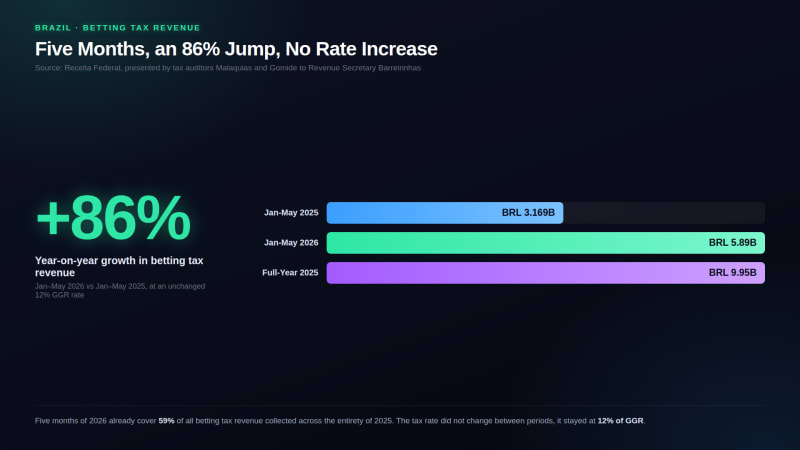
This chart shows Brazil's five-month 2026 betting tax revenue against the same period in 2025 and the full 2025 calendar year total.
None of that growth came from a rate increase. Licensed operators paid 12% of gross gaming revenue (GGR) in both comparison periods. A proposed jump to 18%, introduced through Provisional Measure 1,303/2025, expired without reaching a vote in Brazil's Congress. The 12% rate is not frozen indefinitely, however. It is scheduled to climb under existing law: to 13% during 2026, 14% during 2027, and 15% during 2028, a gradual escalation rather than the steeper jump that failed politically.
A few things stand out from the tax data:
- The growth rate outpaces the market's own maturation curve. An 86% year-on-year increase in a market's second full year of regulation typically signals either new entrants or a genuine demand shift, not organic compounding.
- The World Cup landed inside the reporting window. H2 Gambling Capital projected BRL 20 billion to 25 billion in Brazilian betting handle tied to the 2026 FIFA World Cup, a tournament-driven spike that overlaps directly with the five-month period Receita Federal measured.
- The failed 18% rate hike removed a live source of political uncertainty. Licensed operators budgeted through 2025 against the possibility of a 50% relative tax increase. Its expiry, combined with strong voluntary tax growth at 12%, weakens the case for reintroducing it.
The Licensed Market's Scale
Brazil's licensed sector has grown quickly since Law 14.790/2023, the "Lei das Apostas," took effect on 1 January 2025. The law is administered by the Secretaria de Prêmios e Apostas (SPA), a unit of Brazil's Ministry of Finance. Licensed operators generated BRL 12.2 billion in revenue during the first four months of 2026, operating under 78 federal licences covering 138 brands as of August 2025.
The licensing framework itself is demanding by regional standards. A federal licence costs BRL 30 million, covers up to three brands, and runs for five years. Operators must maintain a BRL 5 million reserve, demonstrate at least 20% Brazilian ownership, incorporate locally, and verify every bettor's identity against their CPF using biometric facial recognition. Licensed operators must process deposits and withdrawals through Pix, Brazil's instant payment system, and are prohibited from accepting credit cards or cryptocurrency.
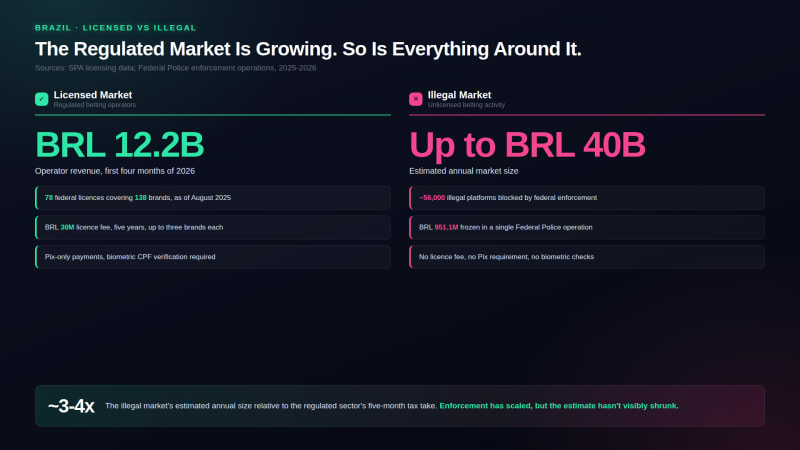
This chart shows Brazil's licensed betting operator revenue against the estimated annual scale of the country's illegal betting market.
That scale still sits well below the illegal market's estimated size. Brazil's unlicensed betting sector is estimated at up to BRL 40 billion annually, a figure that dwarfs both the reported tax take and the reported four-month operator revenue figure. Licensed operators and unlicensed operators are not competing on equal terms: the licensed sector carries the full weight of the framework above, including its biometric KYC, Pix-only payments, and reserve requirements, while illegal platforms carry none of it.
Enforcement Is Scaling, Slowly
Brazilian authorities have expanded enforcement against the illegal betting sector alongside the licensed market's growth. Federal enforcement action has blocked an estimated 56,000 illegal betting platforms, and a single Federal Police operation froze BRL 951.1 million in assets tied to unlicensed operators.
That enforcement has not visibly compressed the illegal market's estimated size. The BRL 40 billion estimate for illegal betting activity has persisted across recent reporting even as blocking and asset-freezing operations have scaled, which suggests displacement, new-platform formation, or measurement lag rather than straightforward market shrinkage. Brazil's regulators face the same structural challenge every jurisdiction with a large informal gambling sector faces: blocking a platform removes that specific domain, not the demand that found it.
Where Brazil Sits Internationally
Brazil's 12% GGR tax rate remains comparatively low even as it climbs toward 15% by 2028. The United Kingdom raised its Remote Gaming Duty to 40% in April 2026. Germany taxes betting turnover, a broader base than GGR, at 5.3%. Colombia charges 15% to 17% of GGR. Peru charges 12% plus a contested 1% consumption tax. Italy charges 24.5% on betting GGR. Sweden charges 22%. Denmark charges 28%.

This chart shows Brazil's tax rate climbing on a scheduled path toward 15% by 2028, still below every GGR-taxed market shown except Peru, while the proposed 18% rate that failed to pass sits shown separately as unenacted.
A few things stand out from that comparison:
- Brazil's scheduled 2028 rate of 15% would still sit below Colombia's current floor. Colombia has taxed betting GGR at 15% to 17% since 2016, a full decade ahead of where Brazil's own escalation schedule lands.
- A lower rate paired with strong voluntary compliance produced Brazil's 86% growth. The UK's move to 40% and Brazil's move toward 15% represent opposite bets on the same underlying question, whether higher rates or broader participation grow tax revenue faster.
- Turnover-based taxation, as in Germany, measures a different base entirely. Germany's 5.3% rate applies to every euro staked rather than operator margin, making direct rate comparisons across countries unreliable without adjusting for base.
What This Means for the Market
Brazil's tax data argues against reviving the failed 18% rate increase in the near term. A market that grew tax revenue 86% at a stable 12% rate gives regulators little immediate fiscal reason to force a steeper jump, particularly with the existing 13%-to-15% escalation already scheduled through 2028. The more pressing question is whether enforcement can compress the illegal market's BRL 40 billion estimated scale faster than the licensed sector can outgrow it organically.
Both dynamics are now running in parallel rather than in sequence. Brazil's licensed betting market is not waiting for the illegal sector to shrink before generating tax revenue, and the illegal sector is not shrinking in response to the licensed market's growth. That parallel track is unusual among newly regulated markets, where enforcement typically precedes or accompanies licensed-market growth rather than trailing behind it.
What to Do Next
- Track Brazil's scheduled tax escalation (13% in 2026, 14% in 2027, 15% in 2028) as the operative trajectory, rather than the failed 18% proposal, when modelling future margins.
- Separate World Cup-driven 2026 handle from baseline growth before drawing conclusions about the market's underlying trajectory, since the tournament fell inside this reporting window.
- Treat the BRL 40 billion illegal market estimate as a standing baseline rather than a shrinking figure until enforcement data shows platform counts falling, not just enforcement actions rising.
- Benchmark Brazil's tax rate against GGR-based markets specifically (Colombia, Peru, Italy, Sweden, Denmark), not turnover-based markets like Germany, when assessing competitiveness.
- Monitor federal licence and brand counts as the clearest indicator of licensed-market consolidation, since 78 licences covering 138 brands as of August 2025 leaves room for both growth and consolidation.
Conclusion
Brazil's regulated betting market generated BRL 5.89 billion in tax revenue in five months without a rate increase, and that number is real. So is the BRL 40 billion illegal market sitting alongside it. Both figures describe the same country's betting activity in the same period, and neither one is currently shrinking the other. Brazil built a fiscally productive licensed market and a technically serious enforcement programme at the same time, and five months of data show both of those things working, in parallel, without yet resolving into a single coherent market.
"An 86% increase in tax revenue in five months is the kind of number that normally only shows up when a market is either brand new or badly under-taxed, and Brazil is both," says Marcus Bianchi, our Betting Content Analyst. "The harder problem is the BRL 40 billion still sitting outside the system. That gap is still the real story here, not the 86%."